Massively parallel reinforcement learning can discover successful behavior long before a policy learns to reproduce it reliably. This work identifies a discovery–mastery gap: successful trajectories are already available in replay, yet reliable task performance emerges much later or remains absent within the training budget.
REAP — return-guided reallocation of the replay budget — gives high-return experience more opportunities to influence learning. It mixes a base sampler with sampling proportional to positive centered return-to-go. Scores are computed once from observed rewards when an episode ends and remain fixed, allowing REAP to work with uniform or recency-based replay and standard off-policy updates.
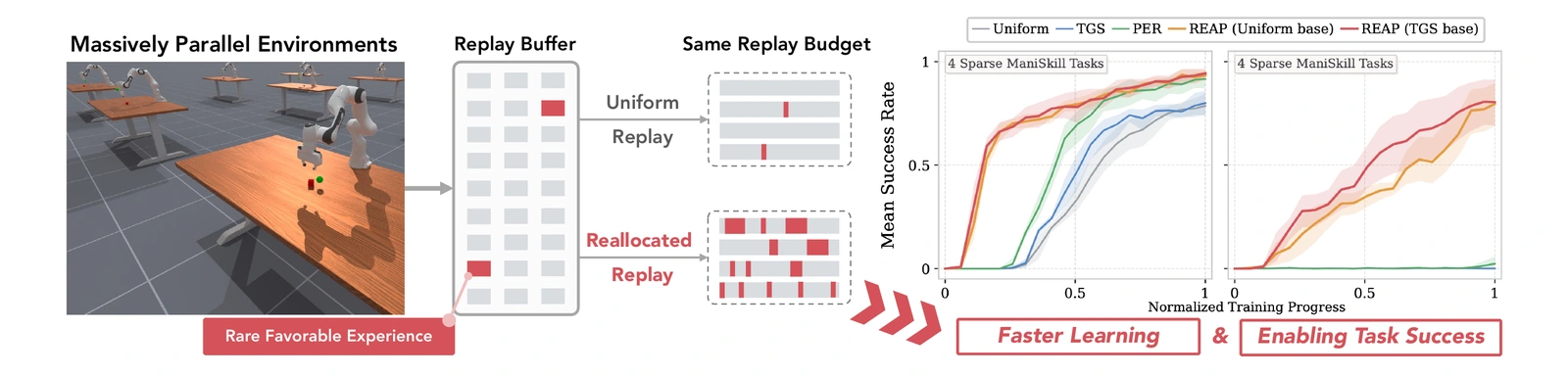
Figure 1. REAP increases replay of rare high-return experience within the same replay budget. The two groups of sparse-reward ManiSkill tasks illustrate faster learning and task success where uniform replay makes little progress.
Across 48 control tasks spanning ManiSkill, Genesis, Isaac Lab, and MuJoCo Playground, REAP improves aggregate learning performance. On eight sparse-reward tasks, it enables success on four where uniform and recency-based replay remain near zero and accelerates learning on the other four. These comparisons keep interaction and update budgets fixed.